


Aging Plastics Pipes: An Underrecognized Source Of Microplastics In Domestic Water
Compliance with drinking water standards is not determined solely at the treatment plant. From the source to the tap, water continuously interacts with the distribution system, and its quality can change significantly, particularly when pipes have been in service for many years.
A scientific study published in 2025 in the International Journal of Hygiene and Environmental Health highlights a growing concern: plastic water pipes, especially those made of Polyethylene (PE) and Polyvinyl Chloride (PVC), can become sources of microplastics, nanoplastics, and secondary contaminants over long-term use.
Mechanisms Of PE & PVC Aging In Water Distribution Systems
PE and PVC are the dominant materials used in modern water infrastructure, valued for their corrosion resistance and mechanical durability. However, prolonged exposure to hydraulic flow, pressure fluctuations, and particularly chlorine-based disinfectants gradually degrades their polymer structure.
- For PE pipes, the internal antioxidant protective layer is typically the first to deteriorate. As this layer weakens, the polymer surface develops wrinkling, microcracks, and surface delamination, releasing extremely small polymer fragments into the water.
- For PVC pipes, aging leads to the formation of dense and deep surface pitting on the inner pipe wall, creating a porous, sponge-like structure. From these weakened zones, large quantities of micro- and nanoscale particles can detach and enter the domestic water supply.
It is through these processes that secondary microplastics and nanoplastics begin to emerge in everyday household water.
Microplastics & Nanoplastics In Drinking Water: Biological Risks
Pipe aging does not only generate microplastics smaller than 5 millimeters but also produces nanoplastics, a class of particles with dimensions small enough to raise serious biological concerns.
- Deep penetration potential: Experimental and modeling studies indicate that nanoplastics can cross cellular membranes, enter the bloodstream, accumulate in tissues, and potentially reach the brain.
- The Trojan Horse effect: Aged plastic particles can act as carriers, adsorbing heavy metals such as lead originating from stabilizing additives in PVC pipes, as well as pathogenic microorganisms and other hazardous compounds. These contaminants can then be transported directly into the human body through drinking water consumption.
End-Of-Network Zones: Areas Of Highest Risk
Research confirms that small-diameter pipes below 100 millimeters, typically located at the terminal sections of water distribution networks and supplying individual households, are the most severely affected by aging processes.
In these zones, reduced flow velocity, water stagnation, and declining residual chlorine concentrations create favorable conditions for microbial growth. Microorganisms form biofilms that colonize cracks and pits within the pipe surface, secreting enzymes that accelerate polymer degradation and further intensify material aging.
As a result, the tap within the household itself may represent a point of elevated exposure to microplastics and secondary contaminants, even when the source water continues to meet regulatory quality standards.
Controlling Secondary Risks Within Water Distribution Systems
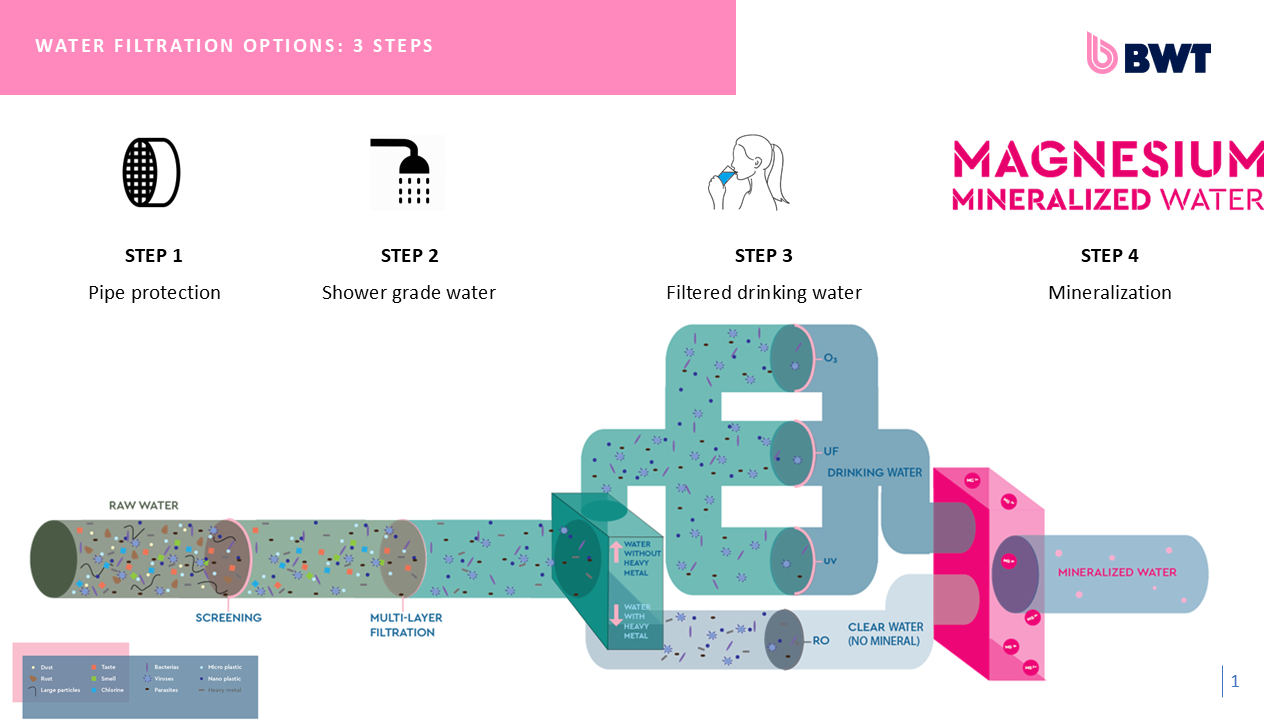
Replacing entire water distribution infrastructures is not feasible in the short term. However, risks can be effectively managed at the point of use. The key challenge lies in addressing secondary contaminants that develop during water transport, a task that basic filtration solutions are often unable to perform adequately.
At BWT, we recognize that clean water is the outcome of a complete system, where pipe age, material characteristics, and operational conditions all play a decisive role. BWT filtration systems are developed based on scientific data and a deep understanding of water chemistry and material behavior:
- Advanced filtration technologies reduce the presence of microplastics, nanoplastics, microorganisms, viruses, and suspended contaminants.
- Physicochemical control limits biofilm formation and prevents the release of heavy metals and dissolved pollutants from aging pipes.
Protecting health is not only about treating water at its source, but also about controlling invisible risks at the point of consumption. This principle lies at the core of BWT’s approach to every water treatment solution.
BWT - Change the World, sip by sip.
- Log in to post comments